
- 2026 Digital Marketing Trends Every Business Should Know

By Digitological – Rajkot’s Trusted Digital Marketing Agency (Now Serving Clients Globally via Upwork) Introduction Digital marketing continues evolving at a rapid pace, and 2026 is shaping up to be one of the most transformative years yet. As consumer behaviors shift and technology advances, businesses must stay ahead of trends to remain competitive. Whether you’re a local business in Rajkot or a global client looking for innovative strategy, understanding these trends will help you grow brand visibility, engagement, and revenue. Artificial Intelligence (AI) Integration Across Marketing Channels AI will power personalization, automated campaign optimization, and predictive analytics. Digitological uses advanced AI tools to help brands outperform competitors. Search Everywhere, Beyond Traditional SEO Brands must optimize for answer engines, AI search, voice search, and visual search. Digitological ensures your brand appears where users actually search. Hyper‑Personalization & First‑Party Data With third‑party cookies disappearing, first‑party data becomes the foundation of personalization. Digitological builds ethical, data‑driven campaigns for conversion growth. Short‑Form Video & Social Commerce Domination Short videos now influence search and shopping. Digitological produces high‑engagement video strategies that drive measurable results. Short‑Form Video & Social Commerce Domination Short videos now influence search and shopping. Digitological produces high‑engagement video strategies that drive measurable results. Conversational Marketing & Voice SEO Voice search and conversational AI require natural‑language optimization. Digitological designs voice‑ready, conversational content for future‑proof visibility. Interactive & Immersive Content AR, quizzes, live sessions, and interactive media boost engagement. Digitological creates immersive experiences that increase dwell time and conversions. Transparency & Trust Digital privacy concerns require ethical and transparent marketing. Digitological ensures trustworthy, compliant strategies. New KPIs & Smarter Measurement Value‑based measurement replaces vanity metrics. Digitological provides actionable analytics tailored to business goals Why Digitological Is the Best Company for Digital Marketing in 2026 Local Expertise, Global Reach Based in Rajkot with expanding Upwork clientele, Digitological understands both regional and international markets. Future‑Ready Strategy We don’t follow trends, we implement them with precision. Data‑Driven Transparency We provide clear reporting and ethical tracking. Customized Strategies Our solutions are built uniquely for each client. Final Thoughts Digital marketing in 2026 is about intelligence, authenticity, and meaningful engagement. Digitological helps brands stay ahead with future‑proof strategies. The post 2026 Digital Marketing Trends Every Business Should Know first appeared on digitological.co.in. The post 2026 Digital Marketing Trends Every Business Should Know appeared first on digitological.co.in.
- What’s App News Update 2025

WhatsApp Flaw Exposes 3.5 Billion Users What It Means & How to Stay Safe WhatsApp Security Flaw Exposed Data of 3.5 Billion Users What You Need to Know Published: November 21, 2025 · Category: Security & Privacy Introduction WhatsApp recently came under intense scrutiny after security researchers discovered a vulnerability in the app’s contact discovery feature that allowed systematic enumeration of active accounts. While end-to-end encryption protected message contents, publicly visible metadata like phone numbers, profile photos and “About” texts could be scraped at scale. Below we explain how the flaw worked, why it matters, and simple steps you can take to protect your privacy. How the Flaw Worked 1. Exploiting Contact Discovery The contact discovery feature is intended to help users find their contacts on WhatsApp by checking phone numbers. Researchers were able to use this same mechanism to systematically probe billions of candidate numbers and confirm which ones were registered. 2. Lack of Effective Rate-Limiting The researchers reported that the platform did not enforce strict rate limits on contact discovery checks. Because of that, they could perform extremely high-volume queries and identify a vast number of active accounts quickly. 3. What Data Was Collected Though private messages were never accessed, the scraped information included: Phone numbers Public encryption keys and account timestamps Profile photos (visible for a large share of accounts) “About” / status text Derived metadata such as device OS and number of linked devices Why This Is a Major Concern Privacy Risks at Scale Individually visible profile details are one thing but aggregated records of billions of accounts are valuable to spammers, scammers, and threat actors who rely on large datasets for targeted attacks or social engineering. Profiling & Targeting Profile photos and status texts can help build reverse phonebooks or be used to better target phishing messages. The scale of this enumeration amplifies those risks significantly. Risks for Users in Sensitive Regions Researchers found active accounts in countries where WhatsApp is restricted or banned, creating additional safety concerns if abused by bad actors or state-level surveillance. Encryption Key Concerns Some accounts showed anomalies in cryptographic key usage a potential sign of misconfigured clients. This finding highlights the need for ongoing scrutiny of client implementations. Design Trade-offs Relying on phone numbers as primary identifiers simplifies onboarding, but it makes large-scale scraping easier. Researchers suggest exploring alternative identity models (for example, usernames) to improve privacy. How Meta / WhatsApp Responded Researchers responsibly disclosed the issue and said they deleted the collected dataset after reporting. WhatsApp implemented stricter rate-limiting measures to prevent mass enumeration. Meta stated there is no evidence of malicious exploitation of the flaw prior to the fix. What You Can Do to Stay Safe 1. Review Privacy Settings Set your profile photo visibility to My Contacts instead of Everyone. Limit who can see your About / status text. 2. Be Wary of Unknown Messages With more valid numbers potentially harvested, phishing attempts or targeted scams may increase. Avoid clicking suspicious links even if they appear to come from a known contact. 3. Keep Your App Updated Install official updates — fixes and protections (like improved rate limiting) are delivered via app updates and server-side changes. 4. Consider Other Messaging Platforms If privacy is critical, consider platforms that don’t use phone numbers as primary identifiers or that explicitly limit contact discovery mechanisms. 5. Stay Informed Follow trusted security researchers and reputable tech publications for updates and best practices. Big Picture & Key Takeaways This incident demonstrates the difference between “public” data and the risk of aggregated public data at scale. Independent academic research plays a crucial role in uncovering systemic privacy issues. Platforms should re-evaluate identity models and improve rate-limiting and metadata protection. Users should manage privacy settings and stay cautious about what personal data they reveal. FAQ — Quick Questions Q: Were WhatsApp messages exposed? No, the researchers report that message content remained protected by end-to-end encryption. The exposure concerned publicly visible metadata like phone numbers and profile photos. Q: Should I stop using WhatsApp? Not necessarily. If you depend on WhatsApp, update regularly and tighten privacy settings. If you need extra privacy, evaluate alternatives that minimize metadata exposure. Conclusion: The WhatsApp contact-discovery flaw is a reminder that even “public” metadata can become dangerous at scale. The fix reduces the immediate risk, but the incident highlights broader platform design and privacy questions. Stay updated and protect your profile data. Subscribe for updates The post What’s App News Update 2025 first appeared on digitological.co.in. The post What’s App News Update 2025 appeared first on digitological.co.in.
- The 10–90 to 90–10 Digital Marketing Strategy

Unlock smarter, faster, and more predictable growth with the 10–90 to 90–10 Digital Marketing Strategy — a powerful framework that starts with rapid experimentation and ends with scalable execution. By dedicating 90% of early efforts to testing and insight, we eliminate guesswork and identify what truly works. Once validated, the strategy flips, directing 90% of resources toward scaling proven campaigns while maintaining ongoing micro-experiments to stay ahead. This approach minimizes risk, maximizes ROI, and builds a long-term, data-driven growth engine. The post The 10–90 to 90–10 Digital Marketing Strategy first appeared on digitological.co.in. The post The 10–90 to 90–10 Digital Marketing Strategy appeared first on digitological.co.in.
- Marketing & Sales Department Handbook Update: What Digital Agencies Must Know AboutMeta & Google’s Latest Platform Changes
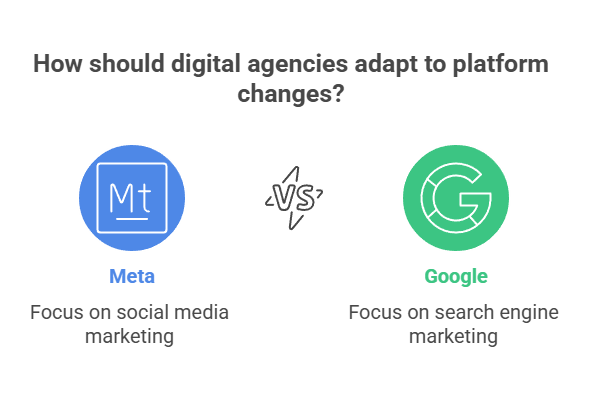
Section 1: Key Updates from Meta Platforms (Nov 2025) 1.1 Messenger Inbox Placement RemovalOne of the most immediate changes: Meta will end delivery of the Messenger Inbox adplacement on 11 November 2025. ([SocialBee])Agency implication: If your agency runs campaigns with manual placements thatinclude Messenger Inbox (or click-to-Messenger entry paths), you must audit and updateimmediately. Leaving this placement active can lead to drop-off or wasted spend as deliveryshifts. (Marga Bagus | Digital Freelancer) 1.2 GA4 Cost-Data Import from MetaMeta now supports the import of its cost data directly into Google Analytics 4 (GA4) via anintegration, simplifying spend tracking, budget reconciliation, and cross-platformmeasurement. (Marga Bagus | Digital Freelancer)Agency implication: This means you andyour Marketing & Sales teams can now build spend-guards, blended cost-per-acquisition(CPA) dashboards, and unified attribution models with less spreadsheet work. It also enablesfaster, more reliable reporting to clients. 1.3 Threads Ads Verification & Format UpgradesMeta’s newer placements, especially Threads, now include third-party verification (viapartners like DoubleVerify, IAS) for brand safety, and allow 4:5 aspect-ratio creatives plusstatic carousel and video formats. (Marga Bagus | Digital Freelancer)Agency implication: Ifyour agency hasn’t yet tested Threads ads, this is a strong “early mover” opportunity. But youmust treat it like a test: allocate a modest budget, use 4:5 formats, track performancecarefully, and evaluate whether this newer placement justifies scale. 1.4 Brand Safety & Fraud ConcernsLeaked documents reveal Meta derived a significant portion of its 2024 revenue from adstied to fraud or banned goods, raising brand-safety risk. (Reuters)Agency implication: Whenpitching to clients, emphasize your agency’s diligence in placement-audit, targeting-filtering,and ROI oversight. This is a key trust factor for clients concerned about brand reputation andad-waste. Section 2: Key Updates from Google LLC (Nov 2025) 2.1 Incrementality Testing Becomes More AccessibleGoogle announced on 11 November 2025 that it is making its incrementality testing toolscheaper, faster, and more accessible, lowering minimum budget requirements fromhistorically large thresholds to as low as $5,000. (PPC Land)Agency implication: For youragency’s Marketing & Sales teams, this opens up a powerful differentiator: you can offerclients true measurement of what would not have happened otherwise (i.e., causal impact)rather than just last-click attribution. This strengthens your value proposition, helps justify fees, and optimizes campaign spend. 2.2 Google Ads = New Features & Brand Suitability ControlsOn the same date, Google also expanded brand-suitability controls (for YouTube Feed &Discover placements) and more transparent reporting for advertisers. (Google Help)Agencyimplication: This strengthens your agency’s ability to ensure safe placements, protect clients’brands, and demonstrate high transparency in performance reporting. 2.3 Search Algorithm Volatility & Reporting ChangesSearch communities noted increasing ranking shifts around 12 November 2025, suggestingThat SEO/organic strategy must also stay alert. (Search Engine Roundtable)Agencyimplication: For your integrated service offering (SEO + paid), you must prepare for potentialripple-effects in search traffic, which can impact ad campaign timing, landing-pageoptimisation and client reporting. Section 3: What This Means for Your Agency’s Marketing & Sales Department 3.1 Aligning Goals & Metrics Shared KPI: blended ROAS (return on ad spend) across Meta + Google platforms,rather than siloed platform metrics. Marketing must report not just leads, but incremental value — i.e., leads that would nothave converted without the campaign. Use Google’s incrementality tools. Sales must feed back into marketing, which placements/formats produce quality leads(e.g., Threads vs traditional placements). 3.2 Updating Processes & Workflow Budget reallocation: With Meta’s removal of Messenger Inbox and Google’s cheaperIncrementality testing, you must re-evaluate budget splits between placements andplatforms. Lead-to-close workflow: Marketing runs new placements like Threads or GA4, cost-imported data; Sales receives better-qualified leads, tracks conversion, and loops in insights back. Monthly review meeting: Marketing presents spend-guard dashboards, conversionanalysis, and incrementality experiment outputs from Google. Sales shares lead quality issues (e.g., Messenger Inbox removal impacted pipeline?). 3.3 Creative & Campaign Strategy Both: emphasise creative freshness, audience re-segmentation, and measurementclarity (not just click-metrics). Meta: ensure ad sets no longer include Messenger Inbox; test Threads formats with4:5 creative and static carousels. Google: run incrementality experiments with clients to prove value, especially forhigher-spend campaigns. 3.4 Tools & Technology Stack Ensure your CRM tracks lead source + placement + experiment status, enabling Salesto feed back to Marketing seamlessly. Ensure your agency’s tech stack supports: cost-data ingestion from Meta into GA4;integration of Google Ads incrementality testing; cross-platform dashboards forMarketing & Sales alignment. Use reporting templates: Spend-Guard (for Meta GA4 cost import) and IncrementalitySummary (for Google). Section 4: Actionable Checklist for Q4 2025 & Beyond Conclusion For digital-marketing agencies, staying ahead of platform updates is not optional — it’sessential. Meta’s November 2025 changes (placement removal, improved measurement,new formats) and Google’s push for more accessible incrementality testing represent majorshifts in how campaigns must be planned, executed and measured. By updating yourinternal handbook, aligning Marketing & Sales teams around new metrics, and adopting theright tools and workflows, your agency will be positioned not only to survive but to thrive inthis newer ad-ecosystem. The early-mover agencies who integrate these changes now willwin both client trust and measurable results. Check Our Other Blog.. Here.. The post Marketing & Sales Department Handbook Update: What Digital Agencies Must Know AboutMeta & Google’s Latest Platform Changes first appeared on digitological.co.in. The post Marketing & Sales Department Handbook Update: What Digital Agencies Must Know AboutMeta & Google’s Latest Platform Changes appeared first on digitological.co.in.
- Search Engine Marketing (SEM) / PPC
What is Search Engine Marketing (SEM) and Pay-Per-Click (PPC)? – A Complete Guide In today’s digital era, where every brand is fighting for visibility online, Search Engine Marketing (SEM) has become a powerful tool to drive instant, targeted traffic to websites. Among the various SEM strategies, Pay-Per-Click (PPC) advertising stands out for its ability to generate measurable and fast results. If you’re new to digital marketing or looking to expand your knowledge, this blog is your go-to guide to understanding SEM and PPC from the ground up. ✅ What is Search Engine Marketing (SEM)? SEM is a form of digital marketing where businesses promote their websites by increasing their visibility in search engine results pages (SERPs)—primarily through paid advertisements. It involves buying ads on platforms like Google Ads, Bing Ads, and YouTube to reach potential customers when they search for related products or services. 💡 What is Pay-Per-Click (PPC)? PPC is the most common model used in SEM. In PPC advertising, you only pay when someone clicks on your ad. Unlike organic SEO, PPC allows your ad to appear instantly for specific keywords, giving you a quick boost in visibility and traffic. Example: If you run an online shoe store and someone searches for “buy running shoes online,” your ad can appear at the top of Google if you’ve bid on that keyword. 🚀 Benefits of SEM/PPC Advertising 🔑 Key Components of a Successful PPC Campaign 📊 Platforms for SEM/PPC Advertising ⚠️ Common Mistakes to Avoid 🎯 Best Practices for SEM/PPC Success The post Search Engine Marketing (SEM) / PPC first appeared on digitological.co.in. The post Search Engine Marketing (SEM) / PPC appeared first on digitological.co.in.